

Unfurling the complexities of veteran identity beyond military service, through:
Art & Design
History & Storytelling
Cultural Expression
Community
Mission
Our mission is to uplift the voices of people who’ve served in the military so that they may redefine what it means to be a veteran—through collaborative arts, education, and cultural programming.
Vision
In highlighting the vast diversity of veteran perspectives and lived-experiences, we aim to simultaneously expand the general public’s understanding of what it means to be a veteran, in and beyond uniform.
Core Values
The foundation of our work, and the three lenses through which we aim to answer one central question: what does it mean to be a veteran?
Storytelling
Existing at the intersection between art and history, we aspire to create a lasting cultural legacy that honors memory, amplifies underrepresented voices, and strengthens connections across veteran communities and the general public. We envision a future in which veteran expression is not separate from culture, but essential to it.
Retrospection
As stewards of history, the only way to fully understand what it means to be a veteran is by contending with various past and present perspectives, during times of both war and peace.
Dialogue
Our commitment to fully examining the complex dynamics of veteran identity requires us to think critically and converse constructively. We seek to establish shared meaning and mutual understanding by facilitating the open exploration of complicated, sometimes contradictory ideas.
Our History
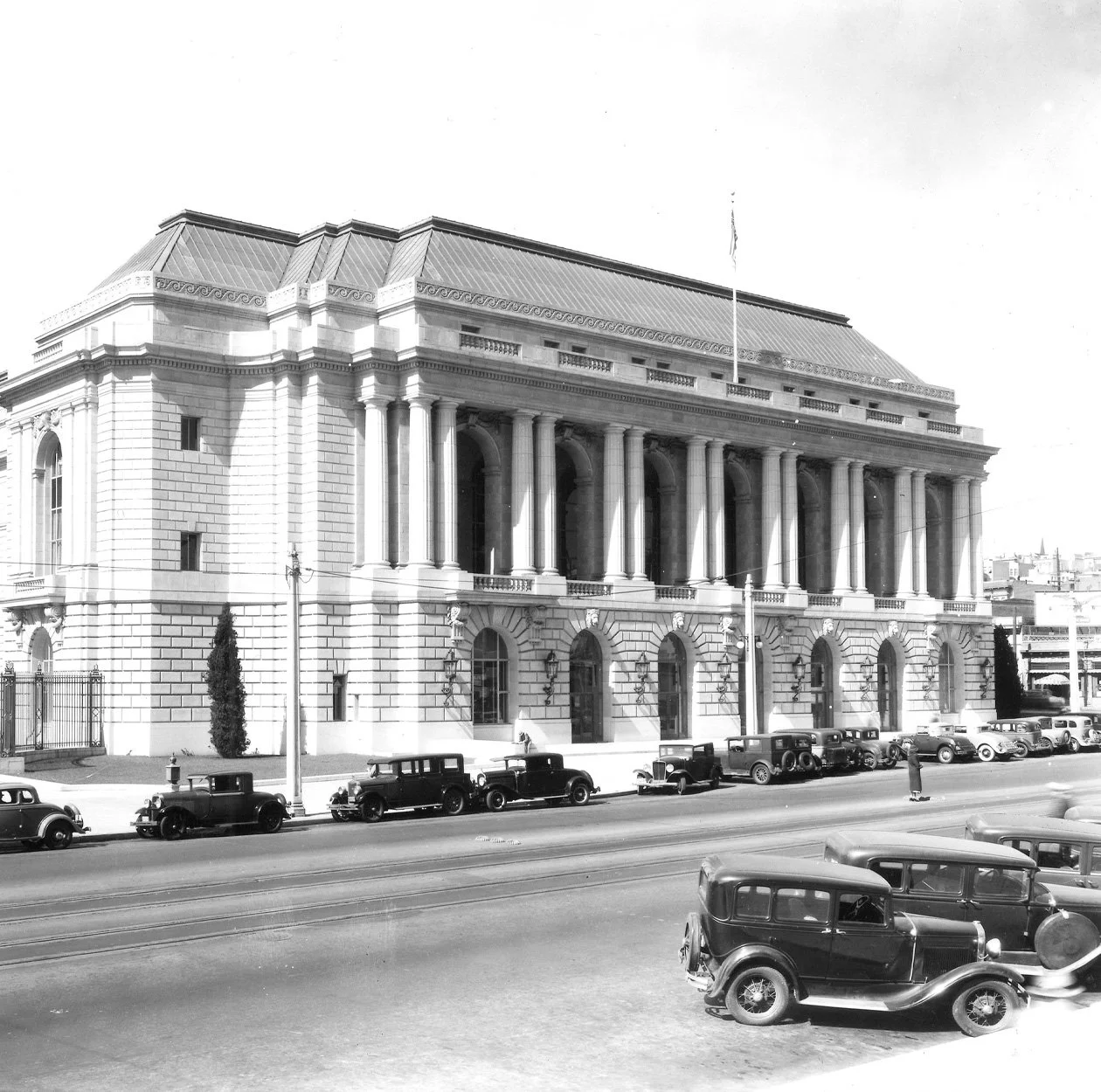
The Veterans Gallery is located on the first floor of the San Francisco Veterans Building, part of the War Memorial Complex in the Civic Center. The complex grew from two separate efforts following World War I. The first began in 1918, when civic leaders proposed a cultural center that would include an opera house, symphony hall, and art museum. The second began in 1919, when veterans organizations started campaigning for a veterans hall and war memorial. In 1920, the two projects were combined into a single plan known as the War Memorial Complex.
The site across from San Francisco City Hall was selected in 1920, and fundraising began through public donations and later a city bond measure. In 1922, a committee of prominent Bay Area architects was assembled to guide the project, including Bernard Maybeck, Willis Polk, John Galen Howard, and Arthur Brown Jr. The final design, created by Arthur Brown Jr. with G. Albert Lansburgh, called for two matching buildings connected by a central court: the War Memorial Opera House and the Veterans Building.
Construction began on January 2, 1931, with the cornerstone laid on Armistice Day, November 11, 1931. One year later, on November 11, 1932, the Veterans Building opened. The Veterans Building was created to serve veterans organizations while also supporting the arts and public life of San Francisco. The building included offices and meeting spaces for veterans groups, memorial spaces, and a large auditorium now known as Herbst Theatre.
The Veterans Building became the site of several major international events. In 1945, representatives from 50 nations gathered there for the United Nations Conference on International Organization. Most meetings took place inside the Veterans Building, while the United Nations Charter was signed across the courtyard in the War Memorial Opera House on June 26, 1945. In 1951, the Japanese Peace Treaty was drafted in the Veterans Building and signed in the Opera House.
Today, the Veterans Gallery continues to uplift the building’s original connection between public culture and veterans’ history. Located on the first floor of the Veterans Building, the gallery presents exhibitions, programs, workshops, and collections focused on community storytelling. The gallery remains part of a larger campus that includes the War Memorial Opera House, Herbst Theatre, the Green Room, Louise M. Davies Symphony Hall, the Wilsey Center, and the Harold L. Zellerbach Rehearsal Hall.
The Veterans Gallery continues to follow the vision imagined by the building’s forebears. It remains a free-to-access space for veterans organizations, public events, exhibitions, and community gatherings, honoring the history of the building through its ongoing public use today.
Preserving Our Historical Record
The Veterans Building and the greater War Memorial Complex is the work of hundreds, if not thousands, of passionate community members, aiming to create a space dedicated to the San Francisco veteran community. Since opening, management of the War Memorial Veterans Building, including the Veterans Gallery, has been supported by a generous community of volunteers. While the history of this space is significant and varied, there are gaps when documentation and oral histories have been lost or disputed, and periods when there was not a historian dedicated to preserving this record. The Veterans Gallery aims to honor these histories and present only substantiated and accurate information. However, we recognize that our historical record is not always complete and that new information may emerge over time. The histories presented here reflect the best information available to us at the time of writing and may contain omissions or inaccuracies. We welcome corrections, additional documentation, and personal recollections that can help us better preserve and share the legacy of the individuals and communities who made this space possible.